
AI Leadership Training for Managers: Where AI Strategy Meets Human Leadership
Posted by BookPal Marketing on Jul 22, 2026
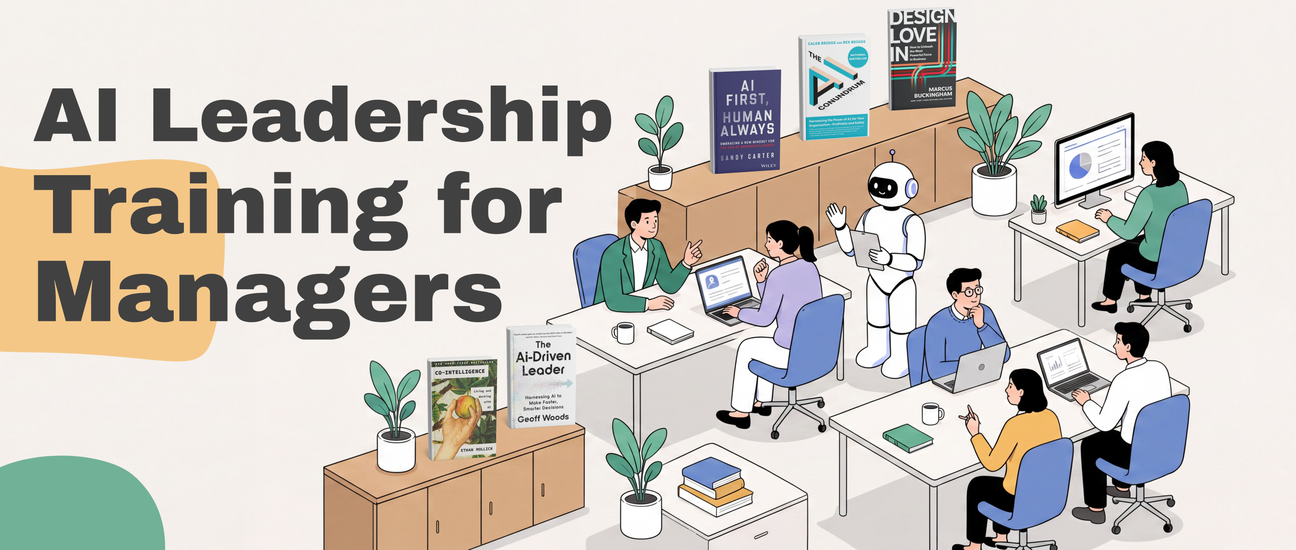
AI is becoming part of everyday work, but training employees to use it is only part of the challenge. Managers also need to know how to lead people whose workflows and responsibilities are changing because of it. Without that preparation, teams can end up with unclear expectations, inconsistent standards, and confusion about when AI should support the work and when human judgment must take the lead.
Managers are now responsible for evaluating AI-assisted work, maintaining accountability, and making sure greater efficiency does not come at the expense of trust, quality, or sound decision-making. That requires strong communication, strategic judgment, and coaching skills.
This guide explains what AI leadership training for managers should include, which human skills matter most, and how organizations can combine AI education with practical leadership development. We’ll also provide our recommended book pairings that HR and L&D teams can use for a structured reading program.
BookPal helps organizations curate, source, and distribute books for leadership development and shared learning programs. Building on our guide to [AI training for employees], this article focuses on the next step: preparing managers to lead the humans using AI.
Key Takeaways:
- Managers need more than basic AI training to lead teams using AI with clear standards, sound judgment, and accountability.
- Augmented leadership combines AI-enabled efficiency with human skills like communication, trust, coaching, and strategic thinking.
- Companion books can pair AI strategy with the leadership skills managers need to apply it responsibly.
- BookPal can help organizations curate and deliver titles that turn AI leadership development into a structured, scalable program
Why Do Managers Need Different AI Training Than Employees?
Employees need to know how to use AI safely and effectively. Managers need to know how to lead the people using it.
Employee AI training often focuses on practical skills such as prompting, protecting sensitive information, checking outputs, and following company policies. Managers need that same foundation, but they are also responsible for setting the standards their teams will follow.
Managers need to answer questions such as:
- When should employees use AI?
- Which tasks require human review?
- How should AI-assisted work be evaluated?
- Who is accountable when AI gets something wrong?
- When should employees disclose that AI contributed to the work?
- Which decisions should remain fully human-led?
Manager AI training cannot stop at tool knowledge. Leaders need the judgment, communication skills, and clear expectations required to turn AI use into responsible team practice.
What Is Augmented Leadership?
Augmented leadership is the practice of using AI to support better work while keeping people, judgment, and accountability at the center.
An augmented leader may use AI to analyze information, summarize feedback, generate ideas, or reduce administrative work. But the manager still decides whether the output is accurate, fair, useful, and appropriate for the situation.
AI can support tasks such as:
- Comparing project options
- Summarizing meetings or feedback
- Identifying patterns in data
- Drafting initial communications
- Reducing repetitive reporting work
What it cannot do is fully understand the team, the organizational context, or the human consequences of a decision.
For example, AI might help a manager review performance data. It should not independently determine why an employee is struggling, whether that employee has received enough support, or what development plan would be most appropriate. That is what makes augmented leadership different from simply using more technology.
Which Human Skills Matter Most for Leaders in the Age of AI?
AI does not make human leadership less important. It makes skills like judgment, communication, trust, and change leadership even more valuable. Managers are responsible for deciding how AI should be used, where human review is required, and how new tools affect the people doing the work.
The most important skills include:
- Strategic judgment: Deciding when AI adds value and when it needs to be questioned.
- Clear communication: Turning AI policies into expectations employees understand.
- Trust and emotional intelligence: Addressing uncertainty without dismissing employee concerns.
- Change leadership: Helping teams adapt as tools and workflows evolve.
- Ethical decision-making: Recognizing risks involving privacy, bias, accuracy, and accountability.
- Coaching: Helping employees build skills instead of simply increasing output.
For example, a manager introducing AI into a customer service team may need to balance faster response times with accuracy and empathy. The tool can help draft a response, but the manager still needs to set standards for when a person should step in.
As AI continues to change workflows, managers will need these human skills to help teams adapt without losing quality, accountability, or connection.
How Can Companion Books Strengthen AI Leadership Training?
Companion books help managers understand both sides of augmented leadership: what AI changes and how leaders should respond. A useful pairing combines one book about AI, strategy, or the future of work with one book focused on a human leadership skill. This gives managers both the context and the practical tools they need.
AI Strategy + Strategic Thinking
The AI-Driven Leader by Geoff Woods
Companion: The Six Disciplines of Strategic Thinking by Michael D. Watkins
This pairing helps leaders connect AI adoption to larger organizational goals instead of using new technology without a clear purpose.
Best for: Senior leaders, department heads, and strategy offsites.
Human-AI Collaboration + Clear Judgment
Co-Intelligence by Ethan Mollick
Companion: Clear Thinking by Shane Parrish
This pairing helps managers explore how AI can support their work while strengthening the judgment needed to question outputs and make better decisions.
Best for: Managers whose teams already use generative AI.
Responsible AI + Decisions Under Uncertainty
The AI Conundrum by Caleb Briggs and Rex Briggs
Companion: Smart Management by Jochen Reb, Shenghua Luan, and Gerd Gigerenzer
This pairing focuses on balancing AI opportunities with risk, safety, and practical decision-making when the right answer is not always obvious.
Best for: Operational leaders, governance teams, and managers leading AI pilots
Human-Centered AI + Communication
AI First, Human Always by Sandy Carter
Companion: Supercommunicators by Charles Duhigg
This pairing helps managers keep people at the center of AI adoption while improving how they explain change, listen to concerns, and build shared understanding.
Best for: HR teams, People Ops leaders, and managers introducing new AI workflows.
More Human Leadership + Trust
More Human by Rasmus Hougaard
Companion: Strong Ground by Brené Brown
This pairing focuses on courage, empathy, accountability, and the human qualities employees still need from their leaders.
Best for: Leadership cohorts, executive teams, and culture-focused programs.
AI Adoption + Employee Connection
How to AI by Christopher Mims
Companion: Design Love In by Marcus Buckingham
This pairing combines practical AI understanding with a stronger focus on employee experience, strengths, and meaningful work.
Best for: Frontline managers, new AI users, and teams beginning workplace adoption.
BookPal’s title recommendation service can help organizations choose companion books based on leadership level, AI experience, and program goals.
Build a More Human AI Leadership Program
AI leadership training works best when managers have both the strategy to understand what is changing and the human skills to lead through it. BookPal can help you curate companion titles for your goals, order books in bulk, and deliver them to one office, multiple locations, or individual managers.
Curate Books for Your Leadership Team
How Can Organizations Use Books in Manager AI Training?
Books work best when they support a larger learning experience. Instead of simply handing managers a title, connect the reading to real workplace decisions, team discussions, and new leadership habits.
- Manager book clubs
- Leadership cohorts
- Executive or manager offsites
- AI pilot programs
- Company-wide development programs
A simple program might include:
- Choose one leadership challenge.
- Select a companion book pairing.
- Give managers time to read and reflect.
- Discuss how the ideas apply to current work.
- Create one new team practice.
- Revisit that practice after 30 or 60 days.
For example, a team introducing new AI workflows could pair an AI strategy book with a communication title. Managers could then discuss:
- Which tasks should always require human review?
- How should AI-assisted work be evaluated?
- What concerns are employees most likely to have?
The goal is to turn reading into shared expectations and practical action.
How Do You Choose the Right Books for Your Managers?
Start with the leadership problem you want to solve, not the most popular AI title.
A strong book selection should match the organization’s goals, the managers’ experience, and the way the program will be used.
Consider questions such as:
- Are managers new to AI or already using it regularly?
- Is the goal awareness, discussion, or implementation?
- Which leadership skill needs the most development?
- Are participants frontline managers, senior leaders, or a mix?
The best pairings cover different but connected ideas.
Avoid selecting two books that make nearly the same point. The value comes from helping managers see both the technology side and the people side of the challenge.
BookPal can also help organizations narrow down titles based on audience, program goals, quantity, and timeline.
How Can Managers Keep Leadership Human as AI Use Grows?
Managers keep leadership human by using AI to support their work without giving up the responsibilities employees still need them to own.
That includes:
- Making final decisions
- Applying context and judgment
- Listening to employee concerns
- Explaining changes clearly
- Setting realistic expectations
- Protecting trust
- Coaching employees through new responsibilities
- Taking accountability when something goes wrong
AI may help a manager process information faster or reduce repetitive work. The real benefit comes from how that saved time is used. When AI reduces administrative work, managers can redirect that time toward thoughtful feedback, coaching, clearer priorities, and stronger employee support.
The goal is not to remove the human side of management. It is to create more space for it.
Better AI Adoption Starts With Better Leadership
Employee AI training teaches people how to use new tools. AI leadership training prepares managers to set expectations, evaluate AI-assisted work, maintain trust, and lead through change.
Companion books help organizations develop both sides of augmented leadership: understanding what AI makes possible and strengthening the human skills required to use it well.
Request a custom quote to start building your augmented leadership program with BookPal.