
The Fall Reset Your Team Needs: A Workplace Book Club
Posted by BookPal Marketing on Aug 05, 2026
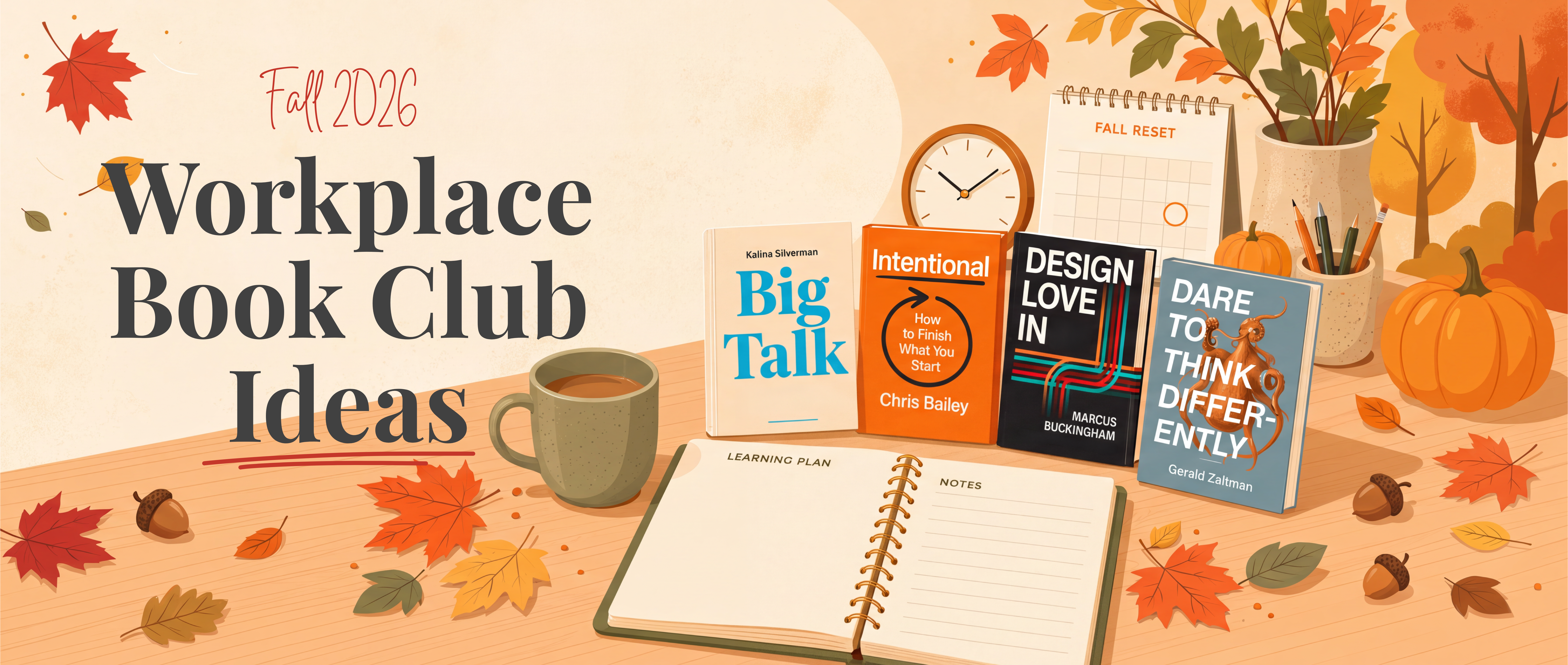
After a summer of vacations, flexible schedules, and shifting workloads, teams can return feeling less connected and less aligned. As year-end priorities come into focus, companies need a simple way to help employees reconnect without adding another major training initiative.
Late August and September offer a natural reset point. A focused workplace book club gives employees one shared topic to explore, discuss, and apply together, creating more structure than a casual team activity without the demands of a full training program.
Over four to six weeks, companies can use one relevant book to strengthen trust, clarify priorities, support wellbeing, or encourage fresh thinking. This guide explains how to choose the right goal, build a manageable reading schedule, and select professional development books that help re-engage employees after summer.
Key Takeaways:
- Fall is a natural time to rebuild team alignment before year-end priorities accelerate.
- A four-to-six-week program is long enough to build momentum without overwhelming employees.
- Start with one learning goal, then choose one book that directly supports that outcome.
- Connect each weekly discussion to a practical behavior or team commitment.
Why Is Fall a Natural Time to Re-Engage Employees?
Fall gives teams a clear opportunity to reconnect just as year-end priorities begin to take shape. After months of vacations, flexible schedules, and staggered workloads, employees may not be disengaged, but they can be working at different rhythms.
Late August and September create a natural transition point. Teams are returning to more consistent schedules, leaders are clarifying fourth-quarter goals, and employees are beginning to think about what needs to be accomplished before the end of the year.
A fall learning reset can help companies use that moment intentionally by giving employees:
- A shared topic to discuss across roles or departments
- Time to reconnect beyond immediate tasks and deadlines
- A clearer connection between professional development and current goals
- Practical ideas they can apply during the final months of the year
- A defined starting and ending point that keeps the initiative manageable
Unlike a one-time kickoff meeting, a shared learning experience gives ideas time to develop. Employees can reflect, discuss what the topic means for their work, and test new behaviors over several weeks.
Books are especially useful for this type of workplace learning program because they create a common reference point without requiring companies to build an entire training curriculum from scratch. A shared title can support discussion while still allowing employees to bring their own experiences and perspectives to the conversation.
Before selecting a book, however, companies need to decide what they want the program to change.
How Do You Choose the Right Goal for a Fall Learning Program?
Start with the outcome, not the book. A short employee learning program works best when it focuses on one clear cultural or business priority.
Choose the goal that best fits your team
- Reconnection, belonging, and trust: Best for teams that need stronger relationships, more meaningful conversations, or greater psychological safety.
- Focus, priorities, and execution: Best for teams that need greater clarity, stronger follow-through, or better coordination before year-end.
- Energy, wellbeing, and sustainable performance: Best for teams experiencing stress, unclear expectations, or pressure to maintain an unsustainable pace.
- Innovation and fresh thinking: Best for teams preparing for annual planning, navigating change, or looking for new approaches to persistent problems.
Before selecting a title, complete this sentence:
At the end of this program, we want employees to think, discuss, or do ______ differently.
The answer will help you choose a book that supports a specific outcome instead of simply selecting the most popular title. Once the goal is clear, the next step is building a program structure that gives employees time to learn and apply the ideas without adding unnecessary complexity.
What Should a 4–6 Week Employee Learning Program Include?
A successful fall learning reset only needs five elements:
- One clear goal
- One shared book
- A realistic reading schedule
- Focused discussions
- One practical way to apply the learning
A four-week program may work for a shorter book or narrow topic. Six weeks gives teams more time to test ideas and decide what should continue.
Before the program: Prepare the rollout
Employees should understand why the book was chosen, what participation involves, and how the topic connects to their work.
Before launch:
- Select the goal and title.
- Decide whether employees will read the full book or selected chapters.
- Create a manageable weekly schedule.
- Prepare two or three discussion questions per session.
- Set clear expectations for participation.
- Confirm book quantities, formats, and delivery timing.
- Give managers or facilitators materials in advance.
The goal is not simply to finish a book. It is to use the book to improve one part of how the team works.
Week 1: Reconnect around the goal
Introduce the topic and explain why it matters now.
Ask:
- Where do we see this challenge in our work?
- What would improvement look like?
- What do we hope to learn together?
Employees should leave with a clear understanding of the program’s purpose.
Week 2: Explore one central idea
Choose one useful concept from the book and connect it to the team’s current experience.
Keep the discussion focused:
- What idea felt most relevant?
- Where does it show up in our work?
- What does it help us see differently?
- What may be difficult to apply?
A few thoughtful questions will usually create a better conversation than a full chapter review.
Week 3: Apply the idea
Ask employees to test one small practice during their normal workweek.
Examples include:
- Adjusting one meeting habit
- Asking a better question in a one-on-one
- Clarifying one priority
- Trying a healthier communication boundary
- Inviting input from someone who speaks less often
- Approaching a familiar problem differently
The activity should fit into existing work rather than becoming another project.
Week 4: Share what changed
Discuss what employees tried and what they noticed.
Ask:
- What worked?
- What felt realistic?
- What did not work as expected?
- What should we continue?
This moves the program from discussion into practical learning.
Weeks 5–6: Create one team commitment
Use the final weeks to turn the strongest idea into an ongoing practice.
The team might:
- Create a new working agreement
- Test an idea on a current project
- Change one meeting or communication norm
- Identify a behavior managers should reinforce
- Set one shared practice for the rest of the year
The program should end with one clear next step, not just a final conversation about the book.
For remote or multi-location teams, plan delivery early so everyone can begin at the same time. BookPal can help with shipping books to offices or individual employees, making it easier to run one shared program across locations.
Need Help Choosing the Right Book for Your Team?
You may know what you want your fall learning program to accomplish without knowing which title will resonate most with your employees. BookPal can recommend books based on your team, learning goal, timeline, and budget, then help coordinate the order when you are ready.
Which Professional Development Books Fit Your Fall Learning Goal?
The best book is not necessarily the most popular one. It is the title that most closely supports the outcome your team wants to achieve.
Each company should choose one goal and one shared title for its fall learning reset. The following recommendations are grouped around four common workplace priorities.
Books for Reconnection, Belonging, and Trust
Mattering by Jennifer Breheny Wallace
Best for helping employees feel valued and recognize the value they contribute.
Mattering gives teams a useful framework for discussing recognition, purpose, connection, and the human need to both feel valued and add value. It is a strong choice for organizations that want to build a more supportive workplace culture.
Big Talk by Kalina Silverman
Best for creating more meaningful workplace conversations.
With practical questions, prompts, and conversation techniques, Big Talk can help employees move beyond surface-level exchanges and build greater empathy, trust, and belonging. Its tools can also be incorporated directly into weekly team discussions.
The 4 Stages of Psychological Safety, Second Edition by Timothy R. Clark
Best for helping employees feel safe to learn, contribute, and speak up.
Clark’s four-stage framework moves from inclusion and learning to contribution and constructive challenge. Teams can use each stage to examine where employees feel supported—and where fear or hesitation may still be limiting participation.

Books for Focus, Priorities, and Execution
Intentional by Chris Bailey
Best for turning important goals into consistent action.
Intentional helps readers organize their daily actions around what matters most, follow through more effectively, and let go of goals or tasks that no longer deserve their attention. It is especially relevant for teams clarifying year-end priorities.
Mission Ready by Lindy Elkins-Tanton
Best for building teams that perform well under pressure.
Drawing on lessons from leading NASA’s Psyche mission, Elkins-Tanton explores how teams can develop the trust, coordination, and shared responsibility required for high-stakes work. It can help employees discuss how they prepare for challenges together rather than relying on individual effort alone.
Inside the Box by David Epstein
Best for using constraints to improve focus and problem-solving.
Inside the Box challenges the idea that unlimited choice always produces better results. It shows how well-chosen limits can help people make decisions, experiment more thoughtfully, and focus their energy where it can have the greatest impact.

Books for Energy, Wellbeing, and Sustainable Performance
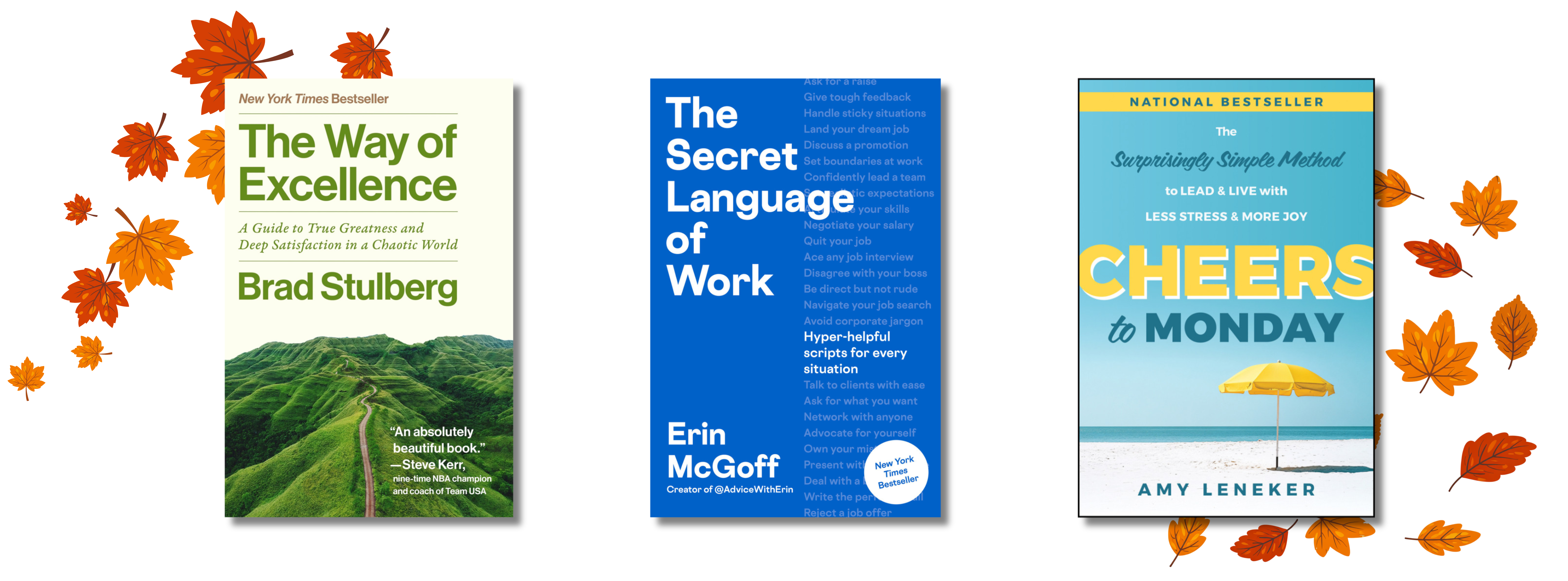
The Way of Excellence by Brad Stulberg
Best for pursuing ambitious goals without falling into hustle culture.
Stulberg distinguishes meaningful excellence from perfectionism, quick fixes, and constant optimization. Teams can use the book to discuss how to pursue strong performance while protecting purpose, satisfaction, and the ability to sustain that work over time.
The Secret Language of Work by Erin McGoff
Best for reducing the stress created by unclear workplace expectations.
This practical guide provides scripts for common professional situations, including setting boundaries, advocating for yourself, navigating difficult conversations, and responding when the right words are hard to find. It can help make unwritten workplace rules feel more manageable.
Cheers to Monday by Amy Leneker
Best for helping employees lead and work with less stress.
Leneker offers a simple framework for recognizing, sorting, and responding to workplace stress. The book creates an approachable way for teams to discuss how stress affects energy, communication, leadership, and the everyday experience of work.
Books for Innovation and Fresh Thinking
Design Love In by Marcus Buckingham
Best for creating more human employee and customer experiences.
Buckingham asks leaders to treat love, the feeling of being seen, valued, and inspired, as something that can be intentionally designed into workplace interactions, policies, products, and services. Teams can apply the concept to one employee or customer experience they want to improve.
Dare to Think Differently by Gerald Zaltman
Best for questioning assumptions and making more open-minded decisions.
Zaltman explores how effective decision-makers move beyond surface-level thinking and examine whether what they believe they know is actually warranted. It is a useful choice for teams that need to consider new alternatives or approach familiar problems differently.
The Creative Shift by Andrew Robertson
Best for making room for new ideas without interrupting everyday work.
The Creative Shift focuses on the challenge of balancing reliable execution with creative exploration. It gives teams practical ways to move into a more innovative mode while continuing to deliver the work the organization already depends on.

How Can BookPal Make a Companywide Learning Program Easier?
Choosing the book is only one part of a successful fall learning reset. Companies also need to confirm availability, distribute copies on time, and make the program accessible to employees across locations.
BookPal can help organizations:
- Build a curated shortlist around a specific learning goal
- Source the selected title and confirm the correct edition
- Provide bulk pricing for companywide orders all in one quote
- Have one dedicated point of contact
- Ship books to one office, multiple locations, or individual employees
- Add custom bookplates, inserts, belly bands, journals, or branded materials
- Coordinate ordering and delivery around the program’s launch date
These services can be especially useful for hybrid and distributed teams. Instead of asking individual employees or managers to purchase their own copies, companies can manage the books through one organized order and create a more consistent experience for every participant.
Give Your Team a Meaningful Second Beginning
A fall employee learning program does not need to become a major training production. One relevant book, one clear goal, and a manageable four-to-six-week schedule can help employees reconnect, explore new ideas, and make practical changes before year-end.
Start by identifying what your team needs most. Choose a title that supports that outcome, build a realistic weekly rhythm, and give employees a clear way to apply what they learn.
Whether you already have a title in mind or need help narrowing the options, BookPal can support the next step, from personalized recommendations and bulk pricing to customization and employee delivery.