
Banned Books Week Activities: Ideas for Classrooms, Libraries, and School Programs
Posted by BookPal Marketing on Sep 24, 2026
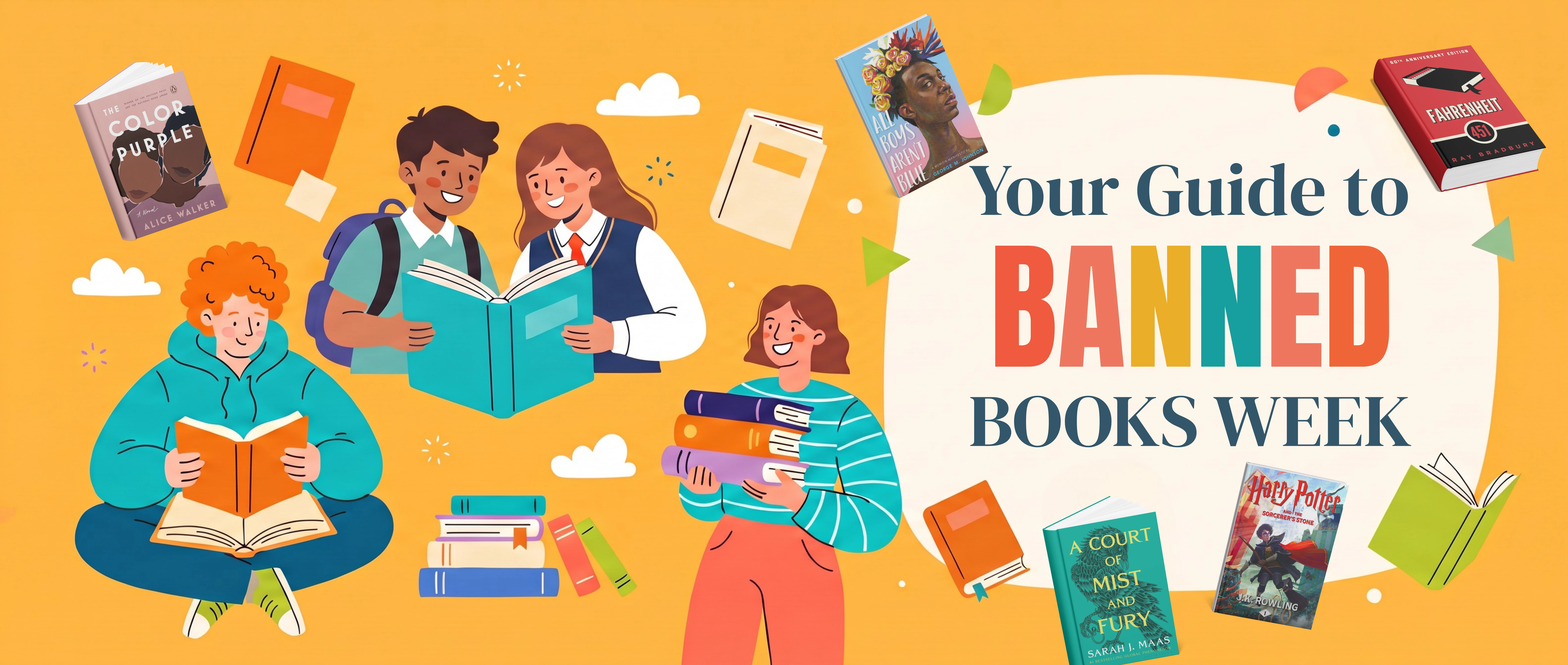
Banned Books Week is more than an opportunity to put challenged titles on display. For educators, it can be a chance to get students reading, asking questions, conducting research, and engaging in thoughtful conversations around books. Taking place October 4–10, 2026, this year's Banned Books Week offers plenty of ways to turn those conversations into meaningful learning experiences for all students.
Whether you're planning for a classroom, library, or school-wide program, the right Banned Books Week activities can help students actively participate rather than simply observe. Drawing on more than 20 years of helping educators bring books into classrooms and school programs, we've put together approachable ideas you can adapt for your students, along with tips for choosing books and determining what you'll need to bring your program to life.
Key takeaways:
- Banned Books Week can become a more meaningful learning experience when students actively read, research, discuss, and explore books, not just look at a display.
- When planning your program, start with what you want students to learn, then build your Banned Books Week activities and book selections around that goal.
- Interactive displays, book tastings, research activities, and student recommendations can be adapted for different grade levels, classrooms, and libraries and keep all students engaged.
- Match your book order to your program. BookPal can help with everything from multiple titles for student choice to classroom sets and larger school programs.
Why Is Banned Books Week Important for Students?
Banned Books Week gives educators an opportunity to use books as a starting point for learning, research, and discussion. The annual event highlights the value of free and open access to information and brings together educators, librarians, booksellers, publishers, authors, and readers around the freedom to read. In 2026, Banned Books Week takes place October 4–10 with the theme “Let Books Be. Protect the Freedom to Read.”
At BookPal, we believe in the power of books to ignite continuous learning and growth. For students, that learning can come from more than reading a challenged book. They can investigate why a title was challenged, compare books across different time periods, ask questions about what they discover, and share their own responses to what they read.
It can also be a useful opportunity to introduce important terminology. The American Library Association (ALA) distinguishes a book challenge, which is an attempt to remove or restrict material based on an objection, from a book ban, which occurs when that material is removed.
What Do You Want Students to Explore During Banned Books Week?
When planning your student program, start with the learning goal, then choose the activity and books that support it. A classroom discussion will require a different approach than an interactive library display, and a research project may call for a wider selection of titles than a shared reading experience.
Depending on your students and setting, your goal might be to:
- Build research skills: Have students investigate when, where, and why different books have been challenged.
- Explore literary history: Compare challenged books from different decades and consider how the circumstances surrounding challenges have changed.
- Encourage book discovery: Introduce students to a selection of books and let them decide which titles they want to explore further.
- Practice thoughtful discussion: Use a shared text to encourage students to ask questions, support their observations, and listen to different interpretations.
- Strengthen student voice: Invite students to create recommendations, displays, discussion questions, or presentations based on what they learn.
For example, instead of beginning with “Which banned books should we display?” an educator might begin with “I want students to practice evaluating sources.” That goal could become a research activity where students investigate the history of several challenged books using credible sources.
Once you know what you want students to explore, you can choose a Banned Books Week activity that makes that goal engaging.
What Are Some Meaningful Banned Books Week Activities for Students?
The best Banned Books Week activities give students something to do with the books, not just something to look at. Research, discovery, discussion, and student-created displays can all turn books into interactive learning experiences.
Here are six approachable ideas that can be adapted for a classroom, school library, or larger program.
1. Solve a “Why Was This Book Challenged?” Mystery
Turn research into a guessing game. Select several age-appropriate challenged books and initially hide their titles. Give students clues such as the publication year, genre, plot description, or historical context and ask them to predict which book they're investigating or why it may have been challenged.
Then reveal the title and have students research the actual challenge history.
The ALA's challenged-book resources and Censorship Search Portal can serve as starting points for researching documented challenges rather than relying on assumptions about why a particular book appeared on a challenged-books list.
Try it: Put each mystery into a folder or envelope and let small groups investigate different books before presenting what they discovered to the class.
2. Explore Challenged Books Through the Decades
Give students a way to see literary history visually by selecting books that have faced challenges during different time periods.
Create stations for several decades and place books, book covers, or information cards at each one. Students can rotate through the stations and record what they notice.
Prompts might include:
- When was the book originally published?
- When or where has it been challenged?
- What reason was given?
- What similarities or differences do you notice between decades?
- What additional questions would you want to research?
Try it: Give each student a sticky note and ask them to leave one surprising thing they learned at the station they found most interesting.
3. Host a Challenged-Book Tasting
A book tasting can turn Banned Books Week into an opportunity for discovery without requiring every student to read the same title.
Set out a selection of books at different tables or stations. Give students a few minutes to explore each title by looking at the cover, reading the description, sampling an appropriate passage, or reviewing information about its challenge history.
Students can keep a simple “menu” and rate which books they would most like to continue reading.
Try it: End with a “My Next Read” card where each student chooses one book they'd like to learn more about and explains what caught their attention.
If you're building a selection for an activity like this, BookPal's curated Banned & Challenged Books catalog can help you explore books that fit your students and program goals.
4. Read, Reflect, and Discuss
Sometimes the simplest activity is also one of the most useful: read something together and give students space to respond.
Depending on your classroom and program, students might read a shared book, an approved excerpt, or different titles in small groups. Instead of beginning with a conclusion, give students open-ended questions that encourage them to investigate the text and its context.
For example:
- What questions did this reading raise for you?
- What perspectives or experiences appear in the book?
- What did you learn when researching the book's challenge history?
- Did anything you discovered surprise you?
Try it: Have students write their first response independently before moving into small-group discussion. At the end, give them an opportunity to add something they learned from another student's perspective.
5. Make Your Banned Books Week Display Interactive
A display can do more than showcase books. Give students a reason to stop, investigate, and contribute.
One simple option is to place a covered card beside each title with information about why or where it has been challenged. Students make a prediction before lifting the card to discover the answer.
You could also add:
- Student-created research cards
- Questions for students to answer on sticky notes
- QR codes linking to approved educational resources
- “What surprised you?” response cards
- Student book recommendations
- A voting area for which book students want to learn more about
ALA has collected additional Banned Books Week display ideas from libraries, including interactive concepts built around guessing titles, uncovering reasons for challenges, and encouraging conversations.
6. Create a Student Recommendation Wall
Let students become the book recommenders.
After students explore or read a title, give them a small card with a prompt such as:
“I think another student should read this book because…”
Add the recommendations to a classroom wall, bulletin board, or library display alongside the books. Students who haven't participated yet can then use their classmates' recommendations to discover something new.
Try it: Add an optional second prompt: “One question I'd ask another reader is…” The wall becomes both a recommendation board and a starting point for future conversations.
These activities become even more meaningful when students aren't simply participating in something created for them, but helping shape the program themselves.
How Can You Make Banned Books Week Activities More Student-Led?
Look for at least one place in your program where students can make a choice, create something, or share what they've learned. Even one interactive component can turn students from observers into contributors.
For example, students could:
- Choose: Vote on which book or topic the class explores next.
- Research: Investigate a challenged title and create a short fact card with what they discover.
- Create: Develop discussion questions, mini reviews, or book recommendations for other students.
- Share: Present one surprising thing they learned about a book or its challenge history.
The activity doesn't need to be complicated. In a school library, students might contribute research cards to an interactive display. In a classroom, small groups could investigate different titles and then teach one another what they found.
Whatever format you choose, make sure activities, titles, and materials are appropriate for your students and consistent with your school or district's policies and guidelines.
Need books for your Banned Books Week program?
Whether you're creating classroom sets, offering several titles for student choice, or organizing a larger school program, BookPal can help you source books in bulk and get the copies you need into students' hands.
How Do You Choose Books for Your Banned Books Week Program?
Choose books based on your students and the purpose of the activity rather than starting with a generic list of frequently challenged titles.
Consider your:
- Students: What grade levels, reading levels, and learning needs are represented?
- Goal: Is the activity focused on research, literary discussion, book discovery, or something else?
- Format: Will everyone explore one shared book or will students choose from several titles?
- Program size: Are you planning for one class, several classrooms, a library, or the whole school?
- School requirements: What school or district guidelines should inform title selection and student access?
- Available time: Does the activity require students to read an entire book, sample several books, or research their histories?
For information about which books have faced challenges and the circumstances surrounding them, educators can use the ALA's challenged-book resources and searchable censorship data. Encourage students to use precise terminology and look at the circumstances surrounding each individual challenge as they conduct their research.
If you know the type of program you want to create but aren't sure which books fit, BookPal can also help with book recommendations based on your audience and program needs.
How Many Books Will You Need for Your Banned Books Week Activities?
The right quantity depends on how students will use the books. You may need one copy of many titles for an interactive display, multiple copies for small-group exploration, or a full classroom set for shared reading.
A few common program formats can help you think through your order:
|
If you're planning... |
Consider... |
|
An interactive library display |
A variety of individual titles students can explore |
|
A challenged-book tasting |
Several titles with enough copies to create stations or small groups |
|
A classroom discussion |
A classroom set if every student will read the same book |
|
Small-group discussions |
Multiple copies of several different titles |
|
A research activity |
A varied collection of titles students can investigate |
|
A larger reading program |
Enough copies of the selected title or titles for participating classrooms or students |
Don't forget the practical details, either. Think about whether books are going to one classroom, several teachers, a library, or multiple campuses and whether your school needs a custom quote or purchase-order support.
BookPal works with schools and districts on bulk book orders, classroom sets, title sourcing, purchase orders, tax-exempt purchasing, and delivery needs, so educators can match the ordering approach to the program they're building.
Planning for October 4–10? If your Banned Books Week activities require student copies, classroom sets, or several different titles, consider getting your book order started soon so you have the materials you need for your program.
And while Banned Books Week provides a natural moment to focus on these activities, the reading and learning don't have to end when the week does.
How Can You Keep Students Engaged With Books Beyond Banned Books Week?
Keep the parts of the program that got students talking, researching, and discovering books. Many Banned Books Week activities can easily become ongoing literacy activities rather than one-week projects.
A student recommendation wall, for example, can become a year-round “Students Recommend” display. Research cards can become part of future library displays. Small-group discussions can turn into classroom or library book clubs.
You can also ask students what they enjoyed most about the week's activities. Their responses can help shape future reading experiences and give them more ownership over how books are explored in the classroom or library.
For educators looking for additional official materials, the ALA provides free Banned Books Week graphics, activities, display inspiration, and other resources that schools and libraries can use when developing their programs.
The goal isn't simply to fill a week with activities. It's to use books as a starting point for curiosity and learning that can continue throughout the school year.
Turn Banned Books Week Into a Meaningful Student Experience
Banned Books Week programming doesn't have to be elaborate to make students active participants. Whether that becomes a mystery activity in one classroom, a student-created library display, or a reading experience across several classrooms, the books should support the experience you want to create.
Still gathering books for your Banned Books Week program? BookPal helps educators and schools source books in bulk for classroom, library, and school-wide reading initiatives. From title recommendations and custom quotes to school purchasing and delivery support, our team can help make getting the books one less thing to worry about.