null
Loading…
Skip to main content Skip to buy box

Holiday gifts by Fri, Dec 18? Order by Thu, Dec 3. Plan gifts Gifts by Dec 18? Order by Dec 3. Plan

Free shipping on most orders over $95 in the contiguous US

Specialists Mon–Fri, 8:30 am–5 pm PTSpecialists Mon–Fri, 8:30–5 PT866-522-6657

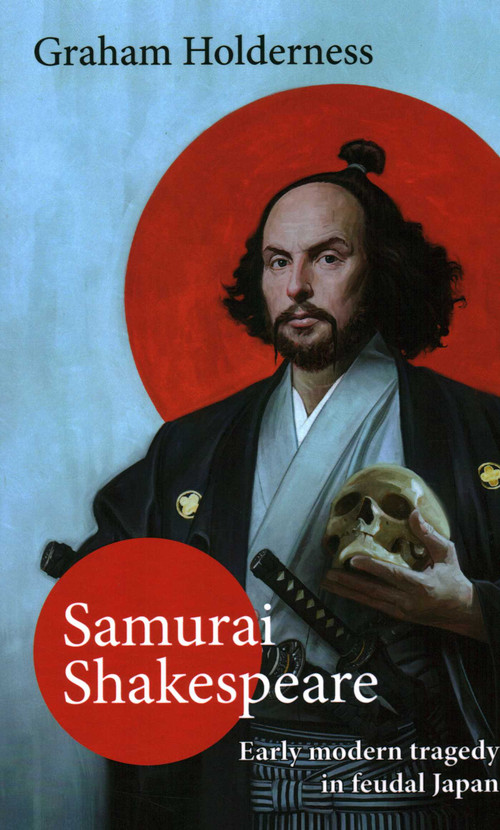
Samurai Shakespeare: Early Modern Tragedy in a Feudal Japan book cover by Graham Holderness
Hardcover

Samurai Shakespeare: Early Modern Tragedy in a Feudal Japan

by Graham Holderness

From $53.07 / copy at 25+ copies; lower per-copy prices at higher quantities (see Volume pricing) As low as $44.08 at 1,000+

Total $1,326.75

Hardcover · 256 pages Edward Everett Root Publishers · 2021

Format

Hardcover
Volume pricing

The more copies, the less each one costs

Applied automatically in your cart. No code needed.

About the book

Samurai Shakespeare

This highly original new book by a leading Shakespeare expert and cultural critic argues controversially that the ‘samurai Shakespeare’ of the Japanese cinematic and theatrical masterpiece-makers Akira Kurosawa and Yukio Ninagawa represents the greatest achievement of Japanese Shakespeare reproduction. Holderness argues that ‘samurai Shakespeare’ is both consistent with our own western engagement with Japan, and true to the spirit of Japanese culture. / Shakespeare was an exact contemporary of Tokugawa Ieyasu. Yet when he was first imported into Japan, in the late 19th century and early 20th centuries, the plays were performed in contemporary dress, not in the conventional British historical styles, and received as the modern counterpart of Ibsen and Shaw, Gorky and Chekhov. / Today in Japan the Edo past is lovingly preserved, reproduced and displayed. Almost 30 million international tourists enter Japan each year to visit the old capitals of Kyoto and Nara, drawn by the magic of Edo castles, ancient temples, swords and samurai, geishas and sumo, maple leaves and cherry blossom. At the same time Japan represents itself as a society of ultra-modernity, free from the burdens of the past. This book examines why and how early Japanese Shakespeare was assimilated to the modernising and westernising tendencies of the Meiji regime, and kept well away from that very recent but dangerous feudal past of Edo Japan to which at least some of the plays should surely have been seen to belong. / When Shakespeare was finally integrated with the Edo past, it was to a contradictory mixture of acclaim and condemnation. In 1957 Akira Kurosawa released his great film Kumonosujo, known in the west as Throne of Blood, where the plot of Macbeth, without Shakespeare’s language, is brilliantly relocated to feudal Japan, and which has been described variously as ‘the most complete translation of Shakespeare into film’ and as ‘not really Shakespeare at all’. Kurosawa followed Kumonosujo much later in 1985 with his samurai version of King Lear, Ran. In the theatre Yukio Ninagawa staged in 1980 what is perhaps the greatest ever Japanese production of Shakespeare, his Macbeth set in mediaeval Japan. Ninagawa produced The Tempest in an equally traditional style, as ‘A Rehearsal of a Noh Play on the Island of Sado’ (the island to which Zeami, the great playwright of Noh, was exiled). Across a period of 30 years (1957-1987) these great theatre and cinema artists finally resolved the conflicts between Shakespeare and Japan by setting the plays back into their own beloved but disputed past. These ‘Samurai Shakespeare’ productions were initially received in the west and in Japan with enthusiasm, though not without some critical reflection on the dangers of ‘exoticism’ and ‘orientalism.’ / However, after this great florescence of ‘samurai Shakespeare’ (1957-1987), the theatre in Japan returned to its Shingeki roots, preferring modernity to tradition. The phenomenon of Edo Shakespeare became a definitive cultural moment, and many subsequent productions allude or pay homage to the work of Fukuda, Kurosawa and Ninagawa. However ultra-modern a Japanese Shakespeare production may be, it has had the facility to acknowledge the country’s own past as one of Shakespeare’s multiple global histories. At the same time ‘Samurai Shakespeare’ can be found alive and well in other Japanese media, especially Manga. / This is an important study of the complexity and contradictions of crucial cultural and historical moments in Japanese history, and in the relations between Japan and the West. / Contents: Introduction: Shakespeare and Japan / 1 ‘Show me a samurai’: western admiration of Edo culture, 1890-1900. / 2 Modernity and tradition in Japanese theatre 1900-1957. / 3 Tsuneari Fukuda / 4 Akira Kurosawa / 5 Yukio Ninagawa / 6 ‘Samurai Shakespeare’ in Japanese theatre 1980-2000. / 7 Conclusion: Manga Shakespeare. / Bibliography, Index.

Details

Publisher
Edward Everett Root Publishers
Author
Graham Holderness
Format
Hardcover
Published
Dec 15, 2021
ISBN-13
9781913087197
ISBN-10
1913087190
Pages
256
Carton quantity
1 copies
Buying for a group

Samurai Shakespeare for groups: pricing

Volume pricing applies automatically in your cart. No codes, no account needed.

CopiesPrice per copyYou save
25 – 99 $53.07 41% off list
100 – 249 $50.37 44% off list
250 – 499 $47.67 47% off list
500 – 999 $45.87 49% off list
1,000+ $44.08 51% off list
Ways groups use it

Popular for

1
Course and classroom adoption

A copy for every student in the class or section.

2
Faculty and staff book studies

Shared reading for professional development.

3
Orientation and campus events

Common reads and first-year programs.

Where can I buy 100 copies of Samurai Shakespeare?

BookPal sells Samurai Shakespeare in quantity. At 100 copies the price is $50.37 a copy, against a list price of $89.95, and the cart applies the volume tier automatically. Free shipping on most orders over $95 in the contiguous US. A specialist can quote a larger or mixed order.

  • New books only, straight from the publisher
  • Volume prices apply automatically in the cart, with no code needed
  • Order at least 10 business days before you need the books (11 from mid-November through December)

Ask a specialist about a larger or mixed order

What does Samurai Shakespeare cost when I buy for a group?

Volume pricing applies automatically in your cart, with no code needed. Price per copy: 25 to 99 copies, $53.07 (41% off list); 100 to 249 copies, $50.37 (44% off list); 250 to 499 copies, $47.67 (47% off list); 500 to 999 copies, $45.87 (49% off list); 1,000+ copies, $44.08 (51% off list). Need a different quantity, or a quote to forward for approval? Ask a specialist and we will confirm pricing before you pay.

How fast can I get copies of Samurai Shakespeare?

Need them by a specific date? Request a quote and we'll confirm timing before you pay.

Can you ship to several locations or people's homes?

Yes. We ship group orders to one address, to multiple sites, or to individual recipients, in the US and internationally. See fulfillment options.

Can I get a formal quote for approval before ordering?

Yes. Request a quote and we'll send a PDF you can forward for approval.

Do you accept purchase orders and tax-exempt orders?

Yes. We accept purchase orders upon approval, as well as cards, PayPal, ACH, wire transfers and checks. BookPal is a tax-exempt supplier in all 50 states. See purchase orders and sales tax exemption.

What if I find a lower price?

Send us the link. We match prices from other booksellers and distributors on a new copy in the same edition, available to ship in the quantity you need. Clearance sales and pricing errors are the exception, and we'll tell you quickly if that's the case. Start a price match.

Send for approval

Get a yes from your approver

Samurai Shakespeare: Early Modern Tragedy in a Feudal Japan
Email it to my approver

Your approver gets a link to this page with the quantity set and an "Approve and order" button. Nothing is sent until you press send in your email app.

Log In
Review Your Cart
Your cart is empty Your cart is empty Your cart is empty

Menu

Recently Viewed Recently Viewed
Back to top Back to top