
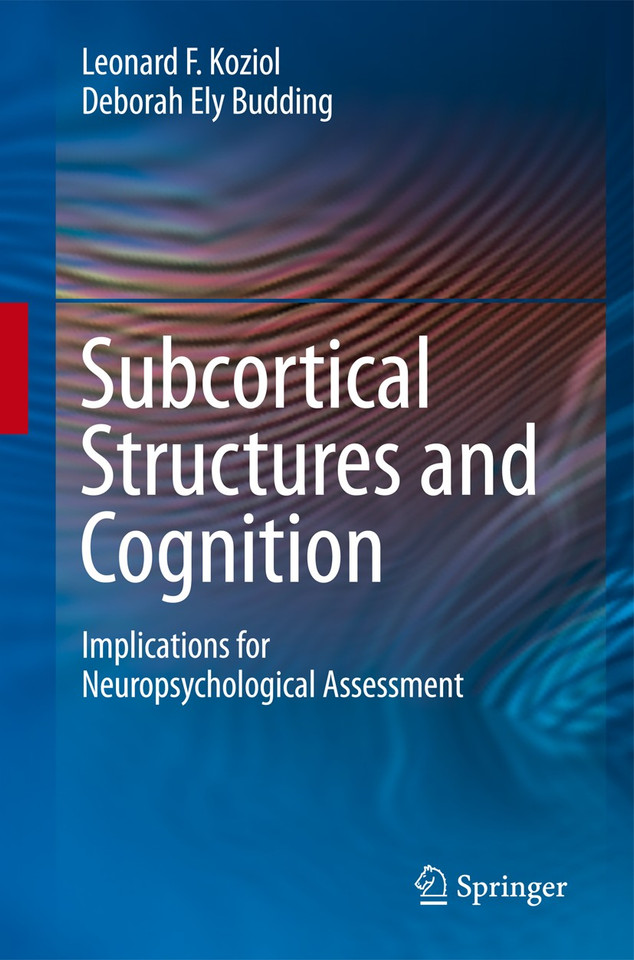
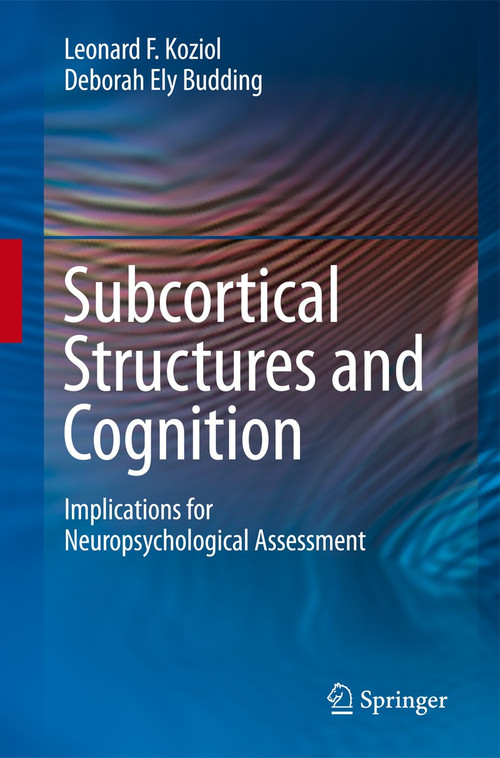
Subcortical Structures and Cognition: Implications for Neuropsychological Assessment
by Leonard F. Koziol and Deborah Ely Budding
From $158.39 / copy at 25+ copies; lower per-copy prices at higher quantities (see Volume pricing) As low as $154.79 at 100+
Total $3,959.75
Format
The more copies, the less each one costs
Applied automatically in your cart. No code needed.
Turn this order into a program
Groups that order together often pair the copies with something more. We handle the extras so you don't have to.
Bookplates, tipped-in pages, belly bands or author signatures. Subject to publisher approval.
Customization options Ship to every readerOne address, many sites or individual recipients' homes, in the US and abroad.
Fulfillment options Pair it with a branded journalJournals with your logo or each reader's name, for the same group.
Branded journals Bring in a speaker
BookPal is partnering with Talezo to help you find and book authors, speakers and performers for your event.
BookPal × TalezoSubcortical Structures and Cognition
Clinical psychologists and neuropsychologists are traditionally taught that cognition is mediated by the cortex and that subcortical brain regions mediate the coordination of movement. However, this argument can easily be challenged based upon the anatomic organization of the brain. The relationship between the prefrontal cortex/frontal lobes and basal ganglia is characterized by loops from these anterior brain regions to the striatum, the globus pallidus, and the thalamus, and then back to the frontal cortex. There is also a cerebrocerebellar system defined by projections from the cerebral cortex to the pontine nuclei, to the cerebellar cortex and deep cerebellar nuclei, to the red nucleus and then back to thalamus and cerebral cortex, including all regions of the frontal lobes. Therefore, both the cortical-striatal and cortical-cerebellar projections are anatomically defined as re-entrant systems that are obviously in a position to influence not only motor behavior, but also cognition and affect. This represents overwhelming evidence based upon neuroanatomy alone that subcortical regions play a role in cognition. The first half of this book defines the functional neuroanatomy of cortical-subcortical circuitries and establishes that since structure is related to function, what the basal ganglia and cerebellum do for movement they also do for cognition and emotion.
The second half of the book examines neuropsychological assessment. Patients with lesions restricted to the cerebellum and/or basal ganglia have been described as exhibiting a variety of cognitive deficits on neuropsychological tests. Numerous investigations have demonstrated that higher-level cognitive functions such as attention, executive functioning, language, visuospatial processing, and learning and memory are affected by subcortical pathologies. There is also considerable evidence that the basal ganglia and cerebellum play a critical role in the regulation of affect and emotion. These brain regions are an integral part of the brain’s executive system. The ability to apply new methodologies clinically is essential in the evaluation of disorders with subcortical pathology, including various developmental disorders (broadly defined to include learning disorders and certain psychiatric conditions), for the purpose of gaining greater understanding of these conditions and developing appropriate methodologies for treatment.
The book is organized around three sources of evidence:
- neuroanatomical connections;
- patients with various disease processes;
- experimental studies, including various imaging techniques.
These three sources of data present compelling evidence that the basal ganglia and cerebellum are involved in cognition, affect, and emotion. The question is no longer if these subcortical regions are involved in these processes, but instead, how they are involved. The book is also organized around two basic concepts: (1) the functional neuroanatomy of the basal ganglia and the cerebellum; and (2) how this relates to behavior and neuropsychological testing.
Cognitive neuroscience is entering a new era as we recognize the roles of subcortical structures in the modulation of cognition. The fields of neuropsychology, cognitive psychology, neuropsychiatry, and neurology are all developing in the direction of understanding the roles of subcortical structures in behavior. This book is informative while defining the need and direction for new paradigms and methodologies for neuropsychological assessment.
Details
- Publisher
- Springer New York
- Authors
- Leonard F. Koziol, Deborah Ely Budding
- Format
- Hardcover
- Published
- Dec 2, 2008
- ISBN-13
- 9780387848662
- Pages
- 405
Subcortical Structures and Cognition for groups: pricing
Volume pricing applies automatically in your cart. No codes, no account needed.
| Copies | Price per copy | You save |
|---|---|---|
| 25 – 49 | $158.39 | 12% off list |
| 50 – 99 | $156.59 | 13% off list |
| 100+ | $154.79 | 14% off list |
Popular for
A copy for every member, on one order.
A book for every attendee, delivered to your venue.
For clients, staff, members or volunteers.
Where can I buy 100 copies of Subcortical Structures and Cognition?
BookPal sells Subcortical Structures and Cognition in quantity. At 100 copies the price is $154.79 a copy, against a list price of $179.99, and the cart applies the volume tier automatically. Free shipping on most orders over $95 in the contiguous US. A specialist can quote a larger or mixed order.
- New books only, straight from the publisher
- Volume prices apply automatically in the cart, with no code needed
- Order at least 10 business days before you need the books (11 from mid-November through December)
What does Subcortical Structures and Cognition cost when I buy for a group?
Volume pricing applies automatically in your cart, with no code needed. Price per copy: 25 to 49 copies, $158.39 (12% off list); 50 to 99 copies, $156.59 (13% off list); 100+ copies, $154.79 (14% off list). Need a different quantity, or a quote to forward for approval? Ask a specialist and we will confirm pricing before you pay.
How fast can I get copies of Subcortical Structures and Cognition?
Need them by a specific date? Request a quote and we'll confirm timing before you pay.
Can you ship to several locations or people's homes?
Yes. We ship group orders to one address, to multiple sites, or to individual recipients, in the US and internationally. See fulfillment options.
Can I get a formal quote for approval before ordering?
Yes. Request a quote and we'll send a PDF you can forward for approval.
Do you accept purchase orders and tax-exempt orders?
Yes. We accept purchase orders upon approval, as well as cards, PayPal, ACH, wire transfers and checks. BookPal is a tax-exempt supplier in all 50 states. See purchase orders and sales tax exemption.
What if I find a lower price?
Send us the link. We match prices from other booksellers and distributors on a new copy in the same edition, available to ship in the quantity you need. Clearance sales and pricing errors are the exception, and we'll tell you quickly if that's the case. Start a price match.
Write a Review
Subcortical Structures and Cognition: Implications for Neuropsychological Assessment
Groups also order
A colleague asked you to approve this order
Your quote list
Add books as you browse, then request one quote for all of them.