
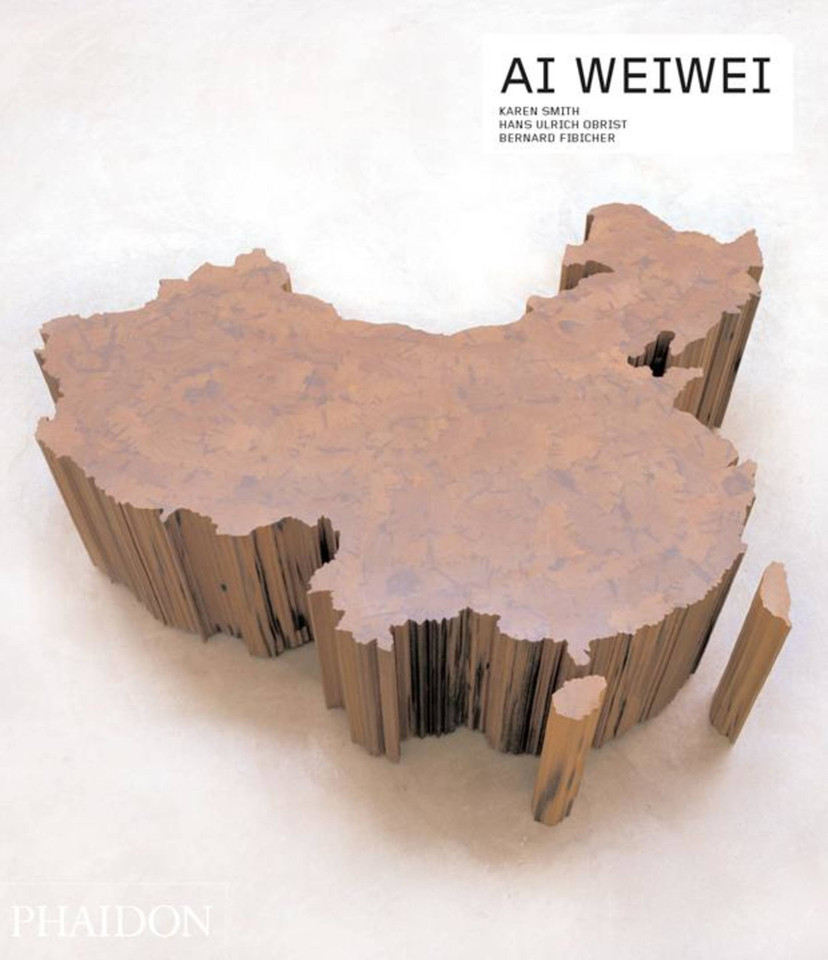
Ai Weiwei (Phaidon Contemporary Artists Series)
by Hans Ulrich Obrist, Karen Smith and Bernard Fibicher
From $36.27 / copy at 25+ copies; lower per-copy prices at higher quantities (see Volume pricing) As low as $31.87 at 1,000+
Total $906.75
Format
The more copies, the less each one costs
Applied automatically in your cart. No code needed.
Turn this order into a program
Groups that order together often pair the copies with something more. We handle the extras so you don't have to.
Branded cover stickers on paperbacks from 100 copies, plus bookplates, inserts and belly bands. Your specialist confirms what fits your title.
Customization options Ship to every readerOne address, many sites or individual recipients' homes, in the US and abroad.
Fulfillment options Pair it with a branded journalJournals with your logo or each reader's name, for the same group.
Branded journals Bring in a speaker
BookPal is partnering with Talezo to help you find and book authors, speakers and performers for your event.
BookPal × TalezoAi Weiwei (Phaidon Contemporary Artists Series)
Ai Weiwei (b. 1957) is truly an artist for the twenty-first century. In his sculptures he refashions artefacts and antiques into surprising, sometimes monumental constructions such as Template (2007): hundreds of wooden doors and windows taken from demolished Ming and Qing dynasty temples and arranged into a massive outdoor sculpture. As much as these materials look to the past, they also speak of the present, because never before (and probably never again) have they been available in such abundance. Like his benches carved from centuries-old temple beams, Template is a sly commentary on the speed with which China's building boom is obliterating its past. (When Template collapsed in a rainstorm two weeks after its unveiling at Documenta 12, the artist embraced its demise as a clever artistic twist.)
In China today, making art that's critical of current cultural and economic policies is not a particularly safe career move. But Ai's father, the poet Ai Qing, walked a similar path, absorbing European avant-garde styles while studying in 1930s Paris and later standing by them in the face of Communist opposition, a move that eventually led to his exile to the distant provincial town where his son Weiwei came to be born and raised. In the late 1970s Ai Weiwei moved to Beijing, banding together with other pro-democracy artists in a loose collective known as the Stars Group. In 1981, following government retaliation against one of their exhibitions, Ai moved to New York, where he attended art school and lived the life of the bohemian for twelve years, his East Village apartment serving as a base for countless visiting Chinese artists. When his father became ill in 1993 Ai returned to China, settling in Beijing and finally taking up his art career in earnest.
Weiwei's artistic forebears belong primarily to the Western modernist avant-garde (Duchamp and Beuys are particularly relevant). But Ai has equally and increasingly been influenced by modernist architecture and contemporary urban planning, citing the need for an ideal for living in a country where runaway economic development has shown little regard for the everyday life of the individual. In stark contrast to the glass-and-steel high-rises going up around Beijing, the art galleries, ateliers and homes Ai designs are boxy and modest, made from brick and other vernacular materials. Their resolution of Eastern and Western styles is a fitting parallel to his antique readymade sculptures.
At a time when the West is finally discovering Chinese contemporary art, Ai is one of the few to have transcended the label 'Chinese artist'. In part thanks to his gallery Urs Meile (Lucerne and Beijing), Ai has won the support of strong European collectors. His work is increasingly being shown at major venues around the world (Kunsthalle Bern, Kunsthaus Graz, Tate Liverpool) and included in major international exhibitions (the Moscow Biennial, the Guangzhou Triennale, Documenta). A complex, multi-faceted artist, Ai is poised to make a deep impact on contemporary art far beyond China's borders.
In the interview Hans Ulrich Obrist discusses Ai Weiwei’s life and motivations, his childhood in a rural province close to the Russian border, his underground political work, his move to New York in the 80s and consequent return to China in the 90s, and his break within the art world.
Karen Smith’s survey examines the evolution of Ai Weiwei’s work from the early paintings, drawings, and sculptures pieces through his most recent installations and architectural work, including the cotton-made sculpture World Map (Biennale of Sydney, 2006), the wooden doors and windows structure Template (Documenta 12, 2007) and his collaboration with the Swiss firm Herzog & de Meuron for the Beijing National Stadium for the 2008 Summer Olympics.
Bernard Fibicher focuses on Working Progress (Fountain of Light) (2007), a site-specific sculpture for Tate Liverpool inspired by Tatlin’s Monument to the Third International (1919) and that takes the form of a spectacular chandelier.
Details
- Publisher
- Phaidon Press
- Authors
- Hans Ulrich Obrist, Karen Smith, Bernard Fibicher
- Format
- Paperback
- Published
- May 16, 2009
- ISBN-13
- 9780714848891
- ISBN-10
- 0714848891
- Pages
- 160
- Carton quantity
- 14 copies
Ai Weiwei (Phaidon Contemporary Artists Series) for groups: pricing
Volume pricing applies automatically in your cart. No codes, no account needed.
| Copies | Price per copy | You save |
|---|---|---|
| 25 – 99 | $36.27 | 34% off list |
| 100 – 249 | $35.17 | 36% off list |
| 250 – 499 | $34.07 | 38% off list |
| 500 – 999 | $32.97 | 40% off list |
| 1,000+ | $31.87 | 42% off list |
Popular for
A copy for every member, on one order.
A book for every attendee, delivered to your venue.
For clients, staff, members or volunteers.
Where can I buy 100 copies of Ai Weiwei?
BookPal sells Ai Weiwei in quantity. At 100 copies the price is $35.17 a copy, against a list price of $54.95, and the cart applies the volume tier automatically. Free shipping on most orders over $95 in the contiguous US. A specialist can quote a larger or mixed order.
- New books only, straight from the publisher
- Volume prices apply automatically in the cart, with no code needed
- Order at least 10 business days before you need the books (11 from mid-November through December)
What does Ai Weiwei (Phaidon Contemporary Artists Series) cost when I buy for a group?
Volume pricing applies automatically in your cart, with no code needed. Price per copy: 25 to 99 copies, $36.27 (34% off list); 100 to 249 copies, $35.17 (36% off list); 250 to 499 copies, $34.07 (38% off list); 500 to 999 copies, $32.97 (40% off list); 1,000+ copies, $31.87 (42% off list). Need a different quantity, or a quote to forward for approval? Ask a specialist and we will confirm pricing before you pay.
How fast can I get copies of Ai Weiwei (Phaidon Contemporary Artists Series)?
Need them by a specific date? Request a quote and we'll confirm timing before you pay.
Can you ship to several locations or people's homes?
Yes. We ship group orders to one address, to multiple sites, or to individual recipients, in the US and internationally. See fulfillment options.
Can I get a formal quote for approval before ordering?
Yes. Request a quote and we'll send a PDF you can forward for approval.
Do you accept purchase orders and tax-exempt orders?
Yes. We accept purchase orders upon approval, as well as cards, PayPal, ACH, wire transfers and checks. BookPal is a tax-exempt supplier in all 50 states. See purchase orders and sales tax exemption.
What if I find a lower price?
Send us the link. We match prices from other booksellers and distributors on a new copy in the same edition, available to ship in the quantity you need. Clearance sales and pricing errors are the exception, and we'll tell you quickly if that's the case. Start a price match.
Write a Review
Ai Weiwei (Phaidon Contemporary Artists Series)
Groups also order



A colleague asked you to approve this order

Your quote list
Add books as you browse, then request one quote for all of them.