null
Loading…
Skip to main content Skip to buy box

Holiday gifts by Fri, Dec 18? Order by Thu, Dec 3. Plan gifts Gifts by Dec 18? Order by Dec 3. Plan

Free shipping on most orders over $95 in the contiguous US

Specialists Mon–Fri, 8:30 am–5 pm PTSpecialists Mon–Fri, 8:30–5 PT866-522-6657

Printed to order
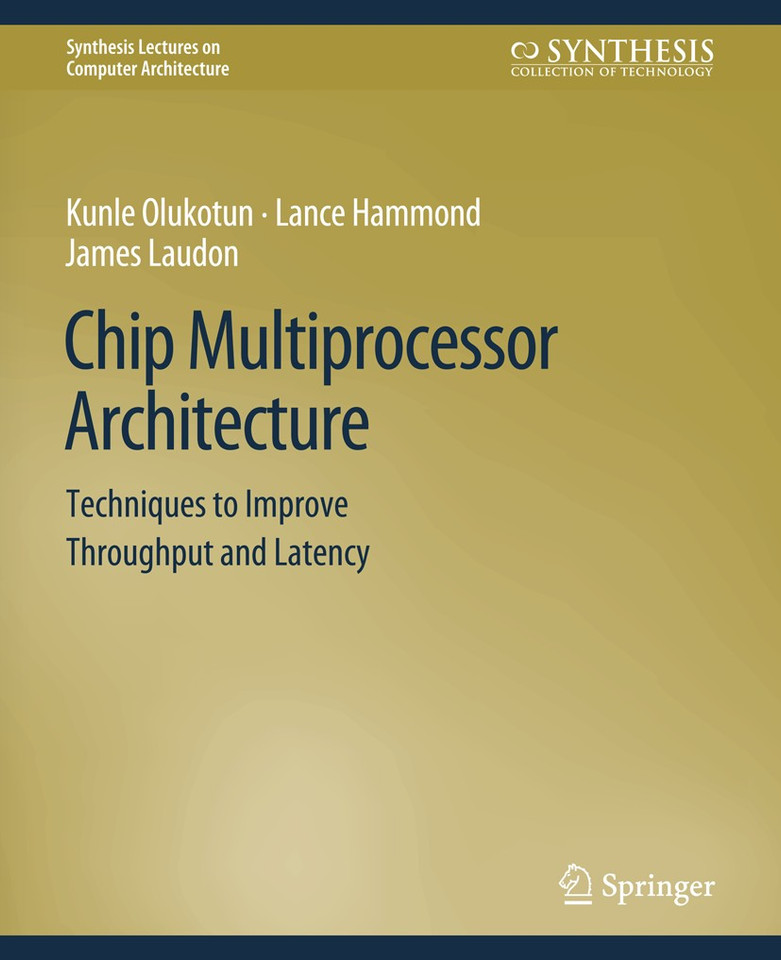
Chip Multiprocessor Architecture: Techniques to Improve Throughput and Latency (Synthesis Lectures on Computer Architecture) book cover by Kunle Olukotun, Lance Hammond, James Laudon
Paperback

Chip Multiprocessor Architecture: Techniques to Improve Throughput and Latency (Synthesis Lectures on Computer Architecture)

by Kunle Olukotun, Lance Hammond and James Laudon

From $33.43 / copy at 25+ copies; lower per-copy prices at higher quantities (see Volume pricing) As low as $32.67 at 100+

Total $835.75

Paperback · 145 pages Springer International Publishing · 2007

Format

Paperback
Volume pricing

The more copies, the less each one costs

Applied automatically in your cart. No code needed.

More than a box of books

Turn this order into a program

Groups that order together often pair the copies with something more. We handle the extras so you don't have to.

About the book

Chip Multiprocessor Architecture

Chip multiprocessors - also called multi-core microprocessors or CMPs for short - are now the only way to build high-performance microprocessors, for a variety of reasons. Large uniprocessors are no longer scaling in performance, because it is only possible to extract a limited amount of parallelism from a typical instruction stream using conventional superscalar instruction issue techniques. In addition, one cannot simply ratchet up the clock speed on today's processors, or the power dissipation will become prohibitive in all but water-cooled systems. Compounding these problems is the simple fact that with the immense numbers of transistors available on today's microprocessor chips, it is too costly to design and debug ever-larger processors every year or two. CMPs avoid these problems by filling up a processor die with multiple, relatively simpler processor cores instead of just one huge core. The exact size of a CMP's cores can vary from very simple pipelines to moderately complex superscalar processors, but once a core has been selected the CMP's performance can easily scale across silicon process generations simply by stamping down more copies of the hard-to-design, high-speed processor core in each successive chip generation. In addition, parallel code execution, obtained by spreading multiple threads of execution across the various cores, can achieve significantly higher performance than would be possible using only a single core. While parallel threads are already common in many useful workloads, there are still important workloads that are hard to divide into parallel threads. The low inter-processor communication latency between the cores in a CMP helps make a much wider range of applications viable candidates for parallel execution than was possible with conventional, multi-chip multiprocessors; nevertheless, limited parallelism in key applications is the main factor limiting acceptance of CMPs in some types of systems. After a discussion of the basic pros and cons of CMPs when they are compared with conventional uniprocessors, this book examines how CMPs can best be designed to handle two radically different kinds of workloads that are likely to be used with a CMP: highly parallel, throughput-sensitive applications at one end of the spectrum, and less parallel, latency-sensitive applications at the other. Throughput-sensitive applications, such as server workloads that handle many independent transactions at once, require careful balancing of all parts of a CMP that can limit throughput, such as the individual cores, on-chip cache memory, and off-chip memory interfaces. Several studies and example systems, such as the Sun Niagara, that examine the necessary tradeoffs are presented here. In contrast, latency-sensitive applications - many desktop applications fall into this category - require a focus on reducing inter-core communication latency and applying techniques to help programmers divide their programs into multiple threads as easily as possible. This book discusses many techniques that can be used in CMPs to simplify parallel programming, with an emphasis on research directions proposed at Stanford University. To illustrate the advantages possible with a CMP using a couple of solid examples, extra focus is given to thread-level speculation (TLS), a way to automatically break up nominally sequential applications into parallel threads on a CMP, and transactional memory. This model can greatly simplify manual parallel programming by using hardware - instead of conventional software locks - to enforce atomic code execution of blocks of instructions, a technique that makes parallel coding much less error-prone. Contents: The Case for CMPs / Improving Throughput / Improving Latency Automatically / Improving Latency using Manual Parallel Programming / A Multicore World: The Future of CMPs

Details

Publisher
Springer International Publishing
Authors
Kunle Olukotun, Lance Hammond, James Laudon
Format
Paperback
Published
Dec 31, 2007
ISBN-13
9783031005923
Pages
145
Printing
Printed on demand
Buying for a group

Chip Multiprocessor Architecture for groups: pricing

Volume pricing applies automatically in your cart. No codes, no account needed.

CopiesPrice per copyYou save
25 – 49 $33.43 12% off list
50 – 99 $33.05 13% off list
100+ $32.67 14% off list
Ways groups use it

Popular for

1
Book clubs

A copy for every member, on one order.

2
Events and conferences

A book for every attendee, delivered to your venue.

3
Gifts

For clients, staff, members or volunteers.

Where can I buy 100 copies of Chip Multiprocessor Architecture?

BookPal sells Chip Multiprocessor Architecture in quantity. At 100 copies the price is $32.67 a copy, against a list price of $37.99, and the cart applies the volume tier automatically. Free shipping on most orders over $95 in the contiguous US. A specialist can quote a larger or mixed order.

  • New books only, straight from the publisher
  • Volume prices apply automatically in the cart, with no code needed
  • Order at least 10 business days before you need the books (11 from mid-November through December)

Ask a specialist about a larger or mixed order

What does Chip Multiprocessor Architecture cost when I buy for a group?

Volume pricing applies automatically in your cart, with no code needed. Price per copy: 25 to 49 copies, $33.43 (12% off list); 50 to 99 copies, $33.05 (13% off list); 100+ copies, $32.67 (14% off list). Need a different quantity, or a quote to forward for approval? Ask a specialist and we will confirm pricing before you pay.

How fast can I get copies of Chip Multiprocessor Architecture?

This title is printed on demand, so it needs production time before it ships. Need them by a specific date? Request a quote and we'll confirm timing before you pay.

Can you ship to several locations or people's homes?

Yes. We ship group orders to one address, to multiple sites, or to individual recipients, in the US and internationally. See fulfillment options.

Can I get a formal quote for approval before ordering?

Yes. Request a quote and we'll send a PDF you can forward for approval.

Do you accept purchase orders and tax-exempt orders?

Yes. We accept purchase orders upon approval, as well as cards, PayPal, ACH, wire transfers and checks. BookPal is a tax-exempt supplier in all 50 states. See purchase orders and sales tax exemption.

What if I find a lower price?

Send us the link. We match prices from other booksellers and distributors on a new copy in the same edition, available to ship in the quantity you need. Clearance sales and pricing errors are the exception, and we'll tell you quickly if that's the case. Start a price match.

Send for approval

Get a yes from your approver

Chip Multiprocessor Architecture: Techniques to Improve Throughput and Latency (Synthesis Lectures on Computer Architecture)
Email it to my approver

Your approver gets a link to this page with the quantity set and an "Approve and order" button. Nothing is sent until you press send in your email app.

Log In
Review Your Cart
Your cart is empty Your cart is empty Your cart is empty

Menu

Recently Viewed Recently Viewed
Back to top Back to top