
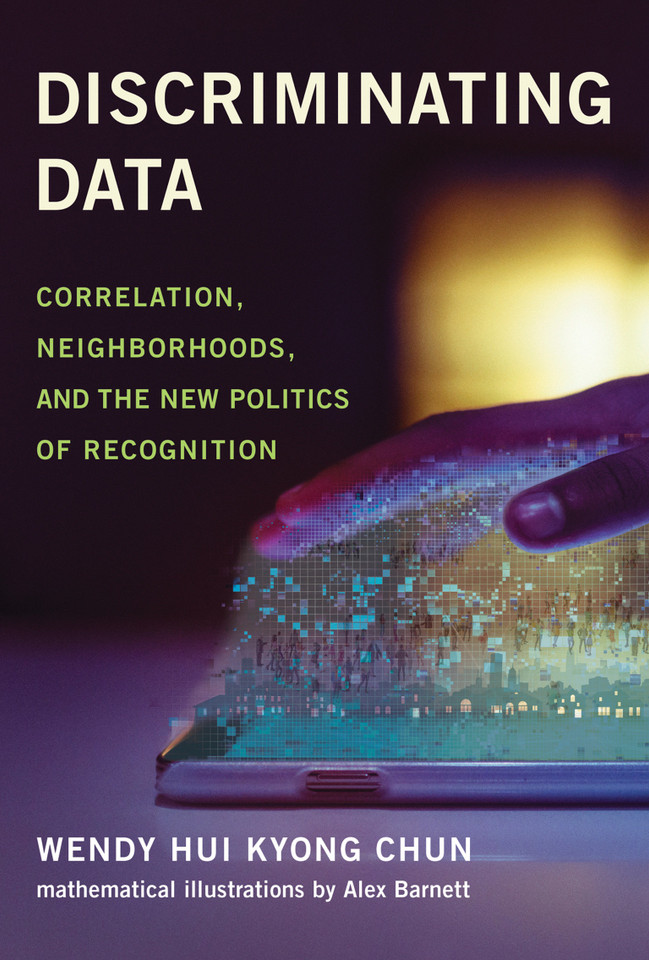
Discriminating Data: Correlation, Neighborhoods, and the New Politics of Recognition
by Wendy Hui Kyong Chun · illustrated by Alex Barnett
From $19.57 / copy at 25+ copies; lower per-copy prices at higher quantities (see Volume pricing) As low as $17.33 at 1,000+
Format
The more copies, the less each one costs
Applied automatically in your cart. No code needed.
Turn this order into a program
Groups that order together often pair the copies with something more. We handle the extras so you don't have to.
Branded cover stickers on paperbacks from 100 copies, plus bookplates, inserts and belly bands. Your specialist confirms what fits your title.
Customization options Ship to every readerOne address, many sites or individual recipients' homes, in the US and abroad.
Fulfillment options Pair it with a branded journalJournals with your logo or each reader's name, for the same group.
Branded journals Bring in a speaker
BookPal is partnering with Talezo to help you find and book authors, speakers and performers for your event.
BookPal × TalezoDiscriminating Data
In Discriminating Data, Wendy Hui Kyong Chun reveals how polarization is a goal—not an error—within big data and machine learning. These methods, she argues, encode segregation, eugenics, and identity politics through their default assumptions and conditions. Correlation, which grounds big data’s predictive potential, stems from twentieth-century eugenic attempts to “breed” a better future. Recommender systems foster angry clusters of sameness through homophily. Users are “trained” to become authentically predictable via a politics and technology of recognition. Machine learning and data analytics thus seek to disrupt the future by making disruption impossible.
Chun, who has a background in systems design engineering as well as media studies and cultural theory, explains that although machine learning algorithms may not officially include race as a category, they embed whiteness as a default. Facial recognition technology, for example, relies on the faces of Hollywood celebrities and university undergraduates—groups not famous for their diversity. Homophily emerged as a concept to describe white U.S. resident attitudes to living in biracial yet segregated public housing. Predictive policing technology deploys models trained on studies of predominantly underserved neighborhoods. Trained on selected and often discriminatory or dirty data, these algorithms are only validated if they mirror this data.
How can we release ourselves from the vice-like grip of discriminatory data? Chun calls for alternative algorithms, defaults, and interdisciplinary coalitions in order to desegregate networks and foster a more democratic big data.
Details
- Publisher
- MIT Press
- Author
- Wendy Hui Kyong Chun
- Format
- Paperback
- Published
- Mar 5, 2024
- ISBN-13
- 9780262548526
- ISBN-10
- 0262548526
- Pages
- 344
- Illustrator
- Alex Barnett
- Carton quantity
- 16 copies
Discriminating Data for groups: pricing
Volume pricing applies automatically in your cart. No codes, no account needed.
| Copies | Price per copy | You save |
|---|---|---|
| 25 – 99 | $19.57 | 30% off list |
| 100 – 249 | $19.01 | 32% off list |
| 250 – 499 | $18.45 | 34% off list |
| 500 – 999 | $17.89 | 36% off list |
| 1,000+ | $17.33 | 38% off list |
Popular for
A copy for every member, on one order.
A book for every attendee, delivered to your venue.
For clients, staff, members or volunteers.
Where can I buy 100 copies of Discriminating Data?
BookPal sells Discriminating Data in quantity. At 100 copies the price is $19.01 a copy, against a list price of $27.95, and the cart applies the volume tier automatically. Free shipping on most orders over $95 in the contiguous US. A specialist can quote a larger or mixed order.
- New books only, straight from the publisher
- Volume prices apply automatically in the cart, with no code needed
- Order at least 10 business days before you need the books (11 from mid-November through December)
What does Discriminating Data cost when I buy for a group?
Volume pricing applies automatically in your cart, with no code needed. Price per copy: 25 to 99 copies, $19.57 (30% off list); 100 to 249 copies, $19.01 (32% off list); 250 to 499 copies, $18.45 (34% off list); 500 to 999 copies, $17.89 (36% off list); 1,000+ copies, $17.33 (38% off list). Need a different quantity, or a quote to forward for approval? Ask a specialist and we will confirm pricing before you pay.
How fast can I get copies of Discriminating Data?
Need them by a specific date? Request a quote and we'll confirm timing before you pay.
Can you ship to several locations or people's homes?
Yes. We ship group orders to one address, to multiple sites, or to individual recipients, in the US and internationally. See fulfillment options.
Can I get a formal quote for approval before ordering?
Yes. Request a quote and we'll send a PDF you can forward for approval.
Do you accept purchase orders and tax-exempt orders?
Yes. We accept purchase orders upon approval, as well as cards, PayPal, ACH, wire transfers and checks. BookPal is a tax-exempt supplier in all 50 states. See purchase orders and sales tax exemption.
What if I find a lower price?
Send us the link. We match prices from other booksellers and distributors on a new copy in the same edition, available to ship in the quantity you need. Clearance sales and pricing errors are the exception, and we'll tell you quickly if that's the case. Start a price match.
Write a Review
Discriminating Data: Correlation, Neighborhoods, and the New Politics of Recognition
Groups also order



A colleague asked you to approve this order
Your quote list
Add books as you browse, then request one quote for all of them.