
Pre-order Releases Apr 28, 2027
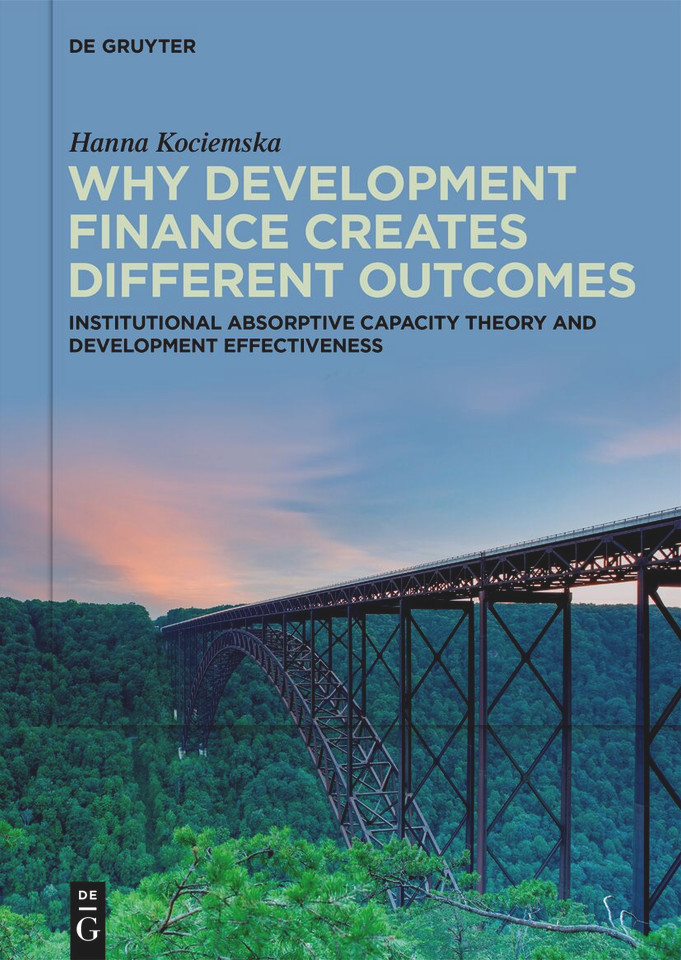
Why Development Finance Creates Different Outcomes: Institutional Absorptive Capacity Theory and Development Effectiveness
From $63.98 / copy at 25+ copies; lower per-copy prices at higher quantities (see Volume pricing) As low as $56.69 at 1,000+
Volume pricing
The more copies, the less each one costs
Applied automatically in your cart. No code needed.
About the book
Why Development Finance Creates Different Outcomes
The book addresses a deceptively simple question with major implications for contemporary development research and policy: why do countries operating within broadly comparable development-finance architectures continue to achieve markedly different outcomes in human development, inequality, multidimensional poverty and environmental performance? Governments, multilateral development banks, development finance institutions and private investors have expanded the range and scale of resources available for sustainable development, yet the expansion of finance has not
produced a corresponding convergence in development outcomes.
The book argues that this divergence is not merely an implementation problem but a theoretical problem. Development Economics explains objectives and structural transformation; Institutional Economics establishes why institutions matter; Political Economy highlights governance and state capability; Sustainable Development Finance explains how resources can be mobilised. These traditions are individually powerful but do not provide an integrated explanation of the institutional process through which financial resources become durable multidimensional outcomes. The book terms this
the Development Effectiveness Paradox.
The central aim is to shift the analytical focus from financial mobilisation to development effectiveness. Financial capital is treated as developmental potential rather than development in itself. Its developmental value depends on institutional systems able to recognise opportunities, integrate resources, coordinate heterogeneous actors, implement policy, generate institutional learning and adapt governance arrangements. The book conceptualises this dynamic capability as Institutional Absorptive Capacity and develops Institutional Absorptive Capacity Theory (IACT) as a mechanism-based
middle-range theory.
The project builds on more than two decades of the author’s research across Public Finance, Public–Private Partnerships, Sustainable Development Finance, governance, human development and institutional analysis, including the Springer monograph Public–Private Partnership for Sub-Saharan Africa (2019). Its contribution is threefold: it reframes development finance around development effectiveness; develops an original mechanism-based institutional theory connecting finance with multidimensional outcomes; and subjects the framework to a transparent empirical evaluation
reporting both supportive and non-supportive evidence. The result is an interdisciplinary research monograph on the institutional transformation of financial capital into sustainable public value.
What readers are saying
Details
- Publisher
- De Gruyter
- Author
- Hanna Kociemska
- Format
- Hardcover
- Release date
- Apr 28, 2027
- ISBN-13
- 9783112283981
- ISBN-10
- 3112283988
- Pages
- 412
Who it's for
Made for teams that read together
Pre-order copies for everyone on your list, and they ship on release.
- Leadership development For new managers and leadership cohorts, a chapter per session. Get a quote
- Company book clubs A shared vocabulary for the whole organization. Get a quote
- Offsites and conferences A takeaway attendees will read, delivered to your venue. Get a quote
- Client and employee gifts One office or each recipient’s home. Get a quote
Before release day
Need them before Apr 28?
Books ship on release and usually arrive around the release date. Early delivery is common, and we arrange it often. It needs the publisher’s OK, so tell us why you need them early and we’ll make the request for you.
- Tell us the date and the reasonA class unit, an event, a program launch: one line is enough.
- We ask the publisherWe make the request on your behalf. It’s a routine part of what we do.
- We confirm with youYour specialist confirms the date by email before anything ships.
Other times a quote is the better path
- Several addressesOne order split across schools, branches, classrooms or homes.
- Signings and eventsTell us the venue and the date, and we’ll plan the delivery around it.
- Custom touchesBookplates, belly bands, gift notes or packaging for your copies.
- Purchase ordersSchools, libraries and agencies can pay by PO.
Why Development Finance Creates Different Outcomes for groups: pricing
Volume pricing applies automatically in your cart. No codes, no account needed.
| Copies | Price per copy | You save |
|---|---|---|
| 25 – 99 | $63.98 | 21% off list |
| 100 – 249 | $61.55 | 24% off list |
| 250 – 499 | $60.74 | 25% off list |
| 500 – 999 | $58.31 | 28% off list |
| 1,000+ | $56.69 | 30% off list |
Where can I buy 100 copies of Why Development Finance Creates Different Outcomes?
BookPal sells Why Development Finance Creates Different Outcomes in quantity. At 100 copies the price is $61.55 a copy, against a list price of $80.99, and the cart applies the volume tier automatically. Free shipping on most orders over $95 in the contiguous US. A specialist can quote a larger or mixed order.
- New books only, straight from the publisher
- Volume prices apply automatically in the cart, with no code needed
- Order at least 10 business days before you need the books (11 from mid-November through December)
What does Why Development Finance Creates Different Outcomes cost when I buy for a group?
Volume pricing applies automatically in your cart, with no code needed. Price per copy: 25 to 99 copies, $63.98 (21% off list); 100 to 249 copies, $61.55 (24% off list); 250 to 499 copies, $60.74 (25% off list); 500 to 999 copies, $58.31 (28% off list); 1,000+ copies, $56.69 (30% off list). Need a different quantity, or a quote to forward for approval? Ask a specialist and we will confirm pricing before you pay.
How fast can I get copies of Why Development Finance Creates Different Outcomes?
This title is not released yet. Pre-orders ship when it is, currently scheduled for April 28, 2027. Need them by a specific date? Request a quote and we'll confirm timing before you pay.
Can you ship to several locations or people's homes?
Yes. We ship group orders to one address, to multiple sites, or to individual recipients, in the US and internationally. See fulfillment options.
Can I get a formal quote for approval before ordering?
Yes. Request a quote and we'll send a PDF you can forward for approval.
Do you accept purchase orders and tax-exempt orders?
Yes. We accept purchase orders upon approval, as well as cards, PayPal, ACH, wire transfers and checks. BookPal is a tax-exempt supplier in all 50 states. See purchase orders and sales tax exemption.
What if I find a lower price?
Send us the link. We match prices from other booksellers and distributors on a new copy in the same edition, available to ship in the quantity you need. Clearance sales and pricing errors are the exception, and we'll tell you quickly if that's the case. Start a price match.
Turn this order into a program
Groups that order together often pair the copies with something more. We handle the extras so you don't have to.
Bookplates, tipped-in pages, belly bands or author signatures. Subject to publisher approval.
Customization options Ship to every readerOne address, many sites or individual recipients' homes, in the US and abroad.
Fulfillment options Pair it with a branded journalJournals with your logo or each reader's name, for the same group.
Branded journals Bring in a speaker
BookPal is partnering with Talezo to help you find and book authors, speakers and performers for your event.
BookPal × TalezoWrite a Review
Why Development Finance Creates Different Outcomes: Institutional Absorptive Capacity Theory and Development Effectiveness
Teams also order




A colleague asked you to approve this order

Your quote list
Add books as you browse, then request one quote for all of them.